Was for EAS 299, now for EAS 244!
(Please excuse any posts that do not relate to our current class)
Thursday, February 26, 2009
This is an photograph I took at a local park. I was making prints of this picture, and I under exposed it, so I decided to colour it.
I felt like this related with our current topic in class, because the photographers also coloured in their pictures. (I used markers, while I am sure their coluring utensils were a little more complicated.)
[I thought I had another version of it up here, but I guess I don't. However you are welcome to look at the pictures or you are bored. There happen to be a couple of other pictures of the same park in this album.]
Pictures taken from Triptych I wanted to start off this album with a picture of a 'modern' Japan. We see a person diving into the pool backwards, I feel that this is also how we view a forgein culture. We don't look at it head on, but we just jump in hoping things will work out. I think this is pretty. I wanted a transitional piece, colour and subject wise. Here we see the water and the buildings in the background, which relate to the picture before it, but the focus of nature is more prevalent. The color of red just jumps out at me, and made me want to do a album with the continuous theme of red and nature. The focus of red is not as prevalent here, but still powerful. And we end with another hint of red being the main focus.
Blue and Red are two of my most favourite colors, so I thought putting them together in an album would be fun. I also think that these pictures give a verity of scenes that would be of interest to Globe Trotters.
<- Copyright 2008, Phillip and Muriel Berman Museum of Art, All Rights Reserved. The image on the left is the image you can find hanging in the Berman Art Gallery. The image below is one that I have edited to bring out the colors and to restore it to what I think the print looked like right off the final wood block.
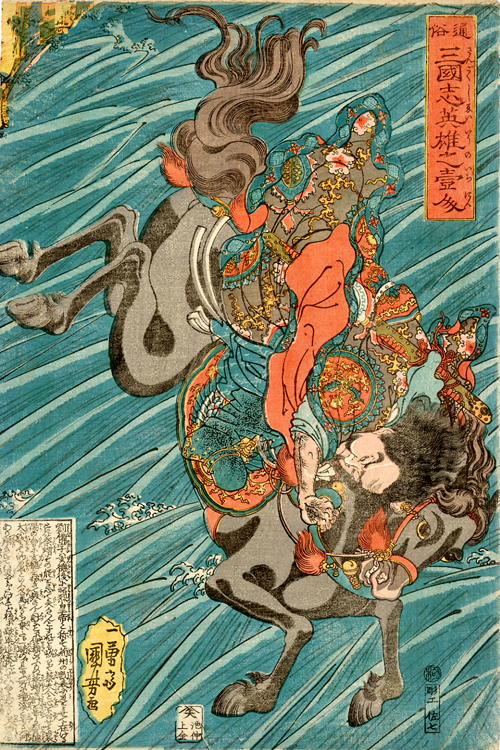
This picture depicts two characters from the epic The Romance of Three Kingdoms, which is one of the most famous epics ever told in China and was created by Utagawa Kuniyoshi. The story opens with a weak government where the emperor was controlled by corrupted eunuchs. The leaders and generals from all the provinces started to fight against these eunuchs, who have split the country into three kingdoms, in order to unite the land of China and restore peace to the country. The story ends, after a little less than a century of war, with China once again united.
This print is called Musha-e, or warrior print. Musha-e became popular after the 1842 banning of Ukiyo-e prints that had to do with Kabuki actors and beautiful women. Because of this ban, Utagawa was able to flourish and become famous for his depictions of famous warriors. Utagawa Kuniyoshi was born in 1797 under the different name of Yanagiya Kichiemon. His father worked in textiles; he dyed silk and designed patterns. Yanagiya’s father asked Yanagiya for help in his work, because Kuniyoshi’s prints often show rich color and detail in the clothing that is said to have been influenced through helping his father. When Yanagiya turned 12 he was already noted for his drawings, but he was not formally accepted into a school until he turned 14 and was admitted into Toyokuni Utagawa’s school of art. Yanagiya was there for three years until he received the name Kuniyoshi at which time he set out to start his own work.
Although Kuniyoshi started off well, his career did not progress for many years until he received the job to create the Tūszoku Suikoden gōketsu hyakuhachinin no hitori, or one hundred and eight heroes of the popular Suikoden. Kuniyoshi became famous for this series and received many other commissions. Kuniyoshi is still most famous for his warrior prints, although he did branch out to many other sections of Ukiyo-e such as Kabuki prints, women and animals, most often depicting felines. Towards the end of his life, Kuniyoshi contracted a crippling disease that left him unable to draw his pictures in the same degree of detail. Kuniyoshi died at the age of 65 in 1862, after having a successful career and being a well admired man and teacher.
I think that these two characters are Liu Bei, the one on the right, and Cao Cao behind him. Liu Bei was one of the heroes in the epic; he started out as a good general and died as the founder of the Kingdom of Shu-Han. I feel that the man on the right is Liu Bei because he looks more like the man you would expect to be a hero, a man that is strong and capable. If we take the man on the right to be Liu Bei, then you can also see how he is played off of the foe behind him. Bei is looking over his shoulder at Cao warily, with a frown that is full of anger- a way that one looks at an enemy. Bei also looks to be steadying himself after having been attacked, he is leaning to the right with his foot and hand ready to catch him and steady him against the incline. Bei, in the epic, seems to be a very grounded man- and his armor reflects that in this image. His clothing stays close to his body, and although it is extravagant, it is fairly form fitting. His clothing is also lighter colored, so it again reinforces the idea that he is a good guy.
As to why I think the person behind Liu Bei is Cao Cao, it is because this man is very insane looking. Cao Cao led the Kingdom of Wei, but in the story he is not described in a flattering manner. He was said to be power hungry and would stop at nothing to get it. He looks animalistic in this picture and does not seem to be able to control himself. He is darker than Bei, and has clothes that seem to be whirling around him. This gives the viewer the impression that he is unstoppable, as well as uncontrollable. He looks to be laughing, which strengthens the impression of insanity or of an animalistic nature. Since his clothing is darker, there also is the idea that he is the bad guy.
As for my first impressions of this piece, they were focused on the characters looking almost like a two headed monster. This ‘monster’ looks scary, big, and hairy, which reflects on how the Japanese viewed foreigners at the time. Also the way that their weapons (which look to be pudaos) cross, draws your eyes up and down the piece. When you first look at the print you see Bei’s staff handle, because it is a light color that draws you in. Next you look at the staff itself; this lets your eye to explore the piece with it as a guide. Then you notice the clothing, faces and finally the background. It appears to be a hill on which grass does not fully cover, so it also gives a feeling of war and unrest. There are also leaves falling from the top of the print, I took this to symbolize the end of the war. Like in fall when the season, or a period of time, ends; the old is disposed of, to be replaced in time by the new.
I also noticed immediately, it was the third note I wrote when I started studying the picture, that there was a major discrepancy in the print. There is a long black line running from the lower left side of the print up until past Cao Cao’s face. It is most noticeable on his face because the line causes some major discoloration. Also because of this defect, there is a rather large white spot on Cao Cao’s pant leg. This is rather distressing because this looks to be a new print because all the lines look to be crisp and bold. I think because of the ‘crack’, or defect, the colors in other parts of the print are also shifted as you can see most clearly in Bei’s left pant leg. However, this seems to not be a unique factor to this print, as you can see in this picture. This Ukiyo-e is also a later print, published in 1836, you can tell because of all the colors and detail put into it.
In conclusion you can see that Kuniyoshi employed a variety of skills in his prints. He added color and patterns into his work that made his prints even more eye catching than other prints at the time. He used perspective to give the print a feeling of hostility and action, while also displaying the character’s personalities. I really like this print, because I think it never gets old to the viewer, because there is always some detail in the clothing or in the landscape that you did not notice before.
Copyright 2008, Phillip and Muriel Berman Museum of Art, All Rights Reserved.
The image on the left is the image you can find hanging in the Berman Art Gallery. The image on the right is one that I have edited to bring out the colors and to restore it to what I think the print looked like right off the final wood block.
(The essay is down here)
This picture depicts two characters from the epic The Romance of Three Kingdoms. The story is one of the most famous ever told in China. The story starts with a weak government where the emperor was controlled by ten wicked eunuchs. These eunuchs caused the government to become corrupted and created many laws that made the people suffer. Because of this the leaders and generals from all provinces started to fight; to unite the land of China and restore peace to the country. The story ends, after a little less than a century of war, with China once again united.
The story main focuses on the 3 major kingdoms that were founded during the civil war. Cao Cao led the Kingdom of Wei, he was a mighty general and great warrior, ambitious yet good in strategy. He gathered the best generals and advisors. Even though Cao Cao was a man with much power, he was unable to unify China.
Sun Quan was made king when his brother was killed in battle, he was still young when he held the throne, but with the great aid from many famous advisors, he formed the Kingdom of Wu. It was a mighty kingdom well known for its skill in marine battle. This was proved when Cao Cao battled with the Wu and Shu armies in Chibi; he ended up losing more than 1 million of his troops.
Liu Bei, said to be son of the late Han emperor, was the sworn brother to Guan Yu and Zhang Fei. Both of them were fierce fighters who accompanied many other famous warriors. These three soon formed, with the help of two other famous men, the 5 Tiger Generals who have become the pillars for the Shu Kingdom. No one can deny that the success of Shu kingdom was also because of the clever strategist, Zhuge Liang, said to be known as the Hidden Dragon. His war tactics have been said to influence China, in many ways.
The story ends with Liu Shan, Liu Bei’s son, surrendering without a battle and conceded the Kingdom of Shu-Han to the Wei Kingdom. In Wu, there was internal conflict among the nobles ever since the death of Sun Quan. There was a struggle for power among the nobles, with many being assassinated but eventually the power of Eastern Wu went back into the hands of the emperor. In Wei, the Wei emperor was forced to abdicate, and Sima Yan established the Jin Dynasty in AD 265, declaring himself the first emperor of the new dynasty. Sima Yan then ordered the Jin troops to attack Eastern Wu from the former land of Shu-Han and succeeded in conquering Eastern Wu after a long period of struggle. And that is the summary of the Romance of the Three Kingdoms.
I think that these two characters are Liu Bei, the one on the right, and Cao Cao. I feel that the man on the right is Liu Bei because he looks more like the man you would expect to be a hero, a man that is mature, strong and capable. If we take the man on the right to be Liu Bei, then you can see how he is played off of the foe behind him. Bei is looking over his shoulder at Cao warily, with a frown that is full of anger- a way that one looks at an enemy. Bei also looks to be steadying himself after having been attacked, he is leaning to the right with his foot and hand ready to catch him and steady him against the incline. Bei, in the epic, seems to be a very grounded man- and his armor reflects that in this image. His clothing stays close to his body, and although it is extravagant, it is fairly form fitting.
As to why I think the person behind Liu Bei is Cao Cao, that is because this man is very insane looking. In my summary I did not really discuss Cao Cao, but in the story he is not described in a flattering manner. He is said to be power hungry and will stop at nothing to get it. He looks animalistic in this picture and does not seem to be able to control himself. He is darker than Bei, and has clothes that seem to be whirling around him. This gives the viewer the impression that he is unstoppable, as well as uncontrollable.
As for my first impressions of this piece, they were focused on the characters looking almost like a two headed monster. This ‘monster’ looks scary, big, and hairy, which reflects on how the Japanese viewed the foreigners. I also noticed immediately, it was my third note I wrote when I started studying the picture, that there was a major discrepancy in the print. There is a long black line running from the lower left side of the print up until past Cao Cao’s face. It is most noticeable on his face because the line causes some major discoloration. Also because of this defect, there is a rather large white spot on Cao Cao’s pant leg. This is rather distressing because this looks to be a new print. There are no problems with the lines, but I think because of the ‘crack’ the colors in other parts of the print are also shifted. This Ukio-e is also a later print, you can tell because of all the colors and detail put into it.
The man who made this print was Utagawa Kuniyoshi, or in the American way of writing names Kuniyoshi Utagawa. Kuniyoshi was born in 1797 under the different name of Yoshisaburō. His father worked in textiles and designed patterns; he apparently enlisted Yoshisaburō for help in his work, because Kuniyoshi’s prints often show rich color and detail in the clothing that is said to have been engraved into his head through helping his father. When Yoshisaburō turned 12 he was already noted for his drawings, but he was not formally accepted into a school until he turned 14 and was admitted into Toyokuni Utagawa’s school of art. Yoshisaburō was there for three years until he received the name Kuniyoshi at which time he set out to start his own work.
Although Kuniyoshi started off well, his career did not progress for many years and he ended up selling used tatami mats at one point to pay bills. But when he received the job to create the Tūszoku Suikoden gōketsu hyakuhachinin no hitori, or one hundred and eight heroes of the popular Suikoden, his career turned right back around. Kuniyoshi became famous for this series and received many other commissions. Kuniyoshi is still most famous for his warrior prints, although he did branch out to many other sections of Ukio-e such as Kabuki prints and animals, most often felines. Kuniyoshi died at the age of 65, after having a successful career and being a well admired man and teacher. He lived to see Yokohama’s ports open to the Westerners, and even attempted to make a print of it, but since he had a crippling disease his detail was not as great as the picture that we see above.
Just to clue you all in- this is a picture I took right outside of a Purikura booth. You can see the purikura machine in the right corner. It was advertising for the "New Version Up" of the 美人 type machine shown above.
NATE'S COMMENT:Ah yes, an advertisement..the classic interpretive image. Well, I can make out some of the kanji and the hirigana, but not enough to read what it is advertising. I also (for hopefully obvious reasons) do not have an interest in modern female fashion in Japan. But, I will take a stab at it.
There are four female models and what appear to be some kinds of sweet treats in the bottom left hand side of the picture. One model looks like she is wearing a wedding dress while another wears an outfit that looks like it was inspired by sailor fuku (once again, I am probably wrong). If this is an advertisement for cakes or sweets, than the signifier is not the food, but the models. The signified (at least from a man's point of view) is that even these gorgeous women eat these treats, so if you eat them, women will like you. However, this probably also has a significant meaning to women. Girls will probably interpret the signified as saying that eating these snacks won't make you fat. I mean, COME ON, look at these gorgeous women! They're not fat!! They are everything that you want to be and yet are not!! They can eat these treats and not even have to worry about becoming unattractive!! It's the perfect snack for the girl who wants to fit in with the popular crowd of skinny, perfect-bodied girls!! Buy now!! Because not even the high sugar and fat content in these snacks will make you fat!! BUY!! BUY!! BUY!!!
...ahem...at least...that is what I think it signifies....
------ My Reply------
I like your idea. As I just wrote above you- it is not food that this ad is selling- it is a popular game of sorts. My idea on this was that the new version was just so wonderful- like sweets! I agree on your point about the models having all this delicious food around them and if they are still skinny then you can be too. I did not think of that when i first saw this. ~*~*~*~*~*~*~*~*~*~
MEGAN'S COMMENT:Hey Claire! When we were talking about this the other day in the library, I seriously did not realize at the time just how ridiculous the images of the women are – you pointed out in particular the foremost face’s flawlessness and lack of pupils, but now I see it more as a sell-out. The figures in the image indulge themselves with a European-American aesthetic, right down to their dyed-brown hair. I wonder what opinion you have, as an American, as to the implications of this imitation. I’m sure that you found it noteworthy, because you made the decision to take the image back with you. Westerners might find it funny, since to us it appears to be overkill, rather than just imitation.
In terms of what the poster advertises, I’m more inclined to believe that it’s trying to sell perfume; it may be a weird assertion, but stick with me for a moment. For one thing, the focus is primarily on the women / models in the poster, rather than the flowers around them or the four or five cakes - if I were selling food (or any other product) I would have that product on full display. Meanwhile, many perfume or cosmetic ads that you find in magazines follow a format close to that of your image above; that is they make NO logical sense (i.e. lack of pupils) and they feature beautiful women. Another thing that I found very interesting was the French-ish, almost ‘couture’ tone of the poster, broadcasting the Western ideal of fashion and elegance. And while the “New Version Up” in the lower right hand corner seems more like a video game phrase, the fact that the poster’s creator chose to have it in English rather than Japanese, adding allurement to their advertisement by introducing the exotic..
-----My Response----- I also like this idea of perfume. I would not have thought of that. I agree- if you are selling food you want the person eating it to be second to catch the eye, not first. argh... the lack of pupils.. I still don't understand why. I mean.. not really attractive. As you know, in Japan they love using english words every chance they can, so i think that is why they stuck in that english phrase at the bottom there. But if you noticed the eglish words, did you not notice the Purikura booth right next to it?
~*~*~*~*~*~*~*~*~
BRIANNA'S COMMENT: This does relate to "This is not a pipe" as it is not a collage of "美人" but a photo of that collage. Of course, we have the context of the photographer, so we can guess that this photo was taken out of intrigue of the depiction of the ideal Japanese beauty.
What I like about the collage depicted is the way it really drills that image into the receiver's head. The word 美人(びじん) and the kanji for beauty (美) are relentless in stressing that this is what beauty looks like. And Megan, I agree with some of the things you said - I mean, we all know that advertising these days follows little particular logic, but those cakes are kinda funny... But I digress... There's a lot packed into that collage, but since this is not about the collage I will end my comment here..
---------My answer-------- you make me sound fancy, but really I just took it because I had a project on Japanese vending machines- and a Purikura booth is a example of one. I agree, all four of these woman look simply gorgeous and flawless and that really stuck with me- until i notcied the lack of pupils.. then I got creeped out. I wondered why on earth they decided to get rid of them.