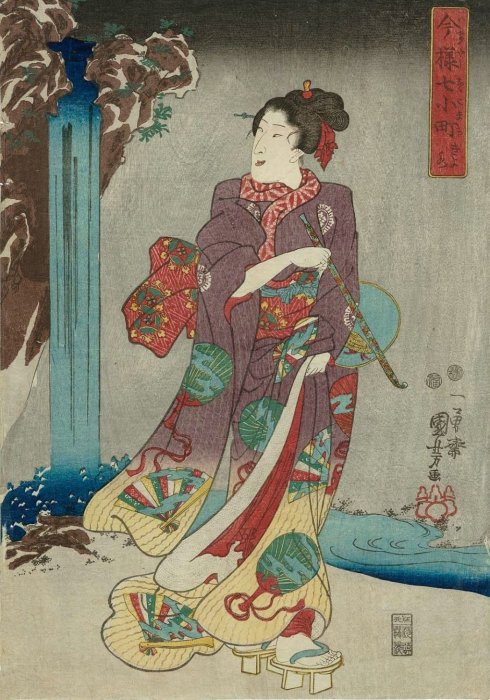
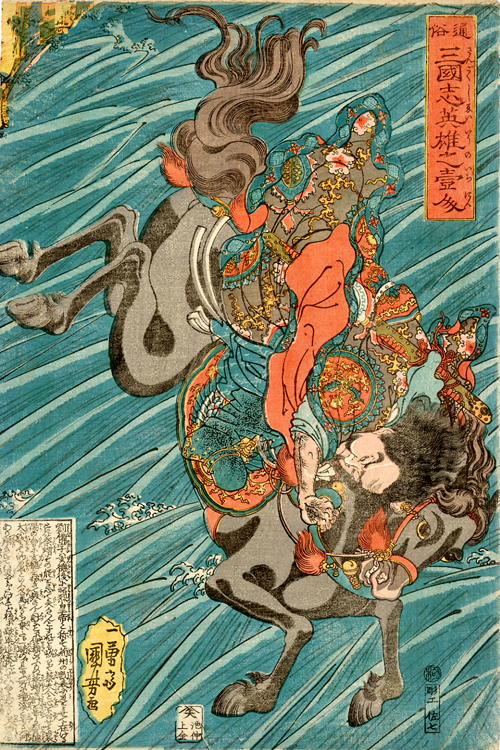
<- Copyright 2008, Phillip and Muriel Berman Museum of Art, All Rights Reserved. The image on the left is the image you can find hanging in the Berman Art Gallery. The image below is one that I have edited to bring out the colors and to restore it to what I think the print looked like right off the final wood block.

This picture depicts two characters from the epic The Romance of Three Kingdoms, which is one of the most famous epics ever told in China and was created by Utagawa Kuniyoshi. The story opens with a weak government where the emperor was controlled by corrupted eunuchs. The leaders and generals from all the provinces started to fight against these eunuchs, who have split the country into three kingdoms, in order to unite the land of China and restore peace to the country. The story ends, after a little less than a century of war, with China once again united.
This print is called Musha-e, or warrior print. Musha-e became popular after the 1842 banning of Ukiyo-e prints that had to do with Kabuki actors and beautiful women. Because of this ban, Utagawa was able to flourish and become famous for his depictions of famous warriors. Utagawa Kuniyoshi was born in 1797 under the different name of Yanagiya Kichiemon. His father worked in textiles; he dyed silk and designed patterns. Yanagiya’s father asked Yanagiya for help in his work, because Kuniyoshi’s prints often show rich color and detail in the clothing that is said to have been influenced through helping his father. When Yanagiya turned 12 he was already noted for his drawings, but he was not formally accepted into a school until he turned 14 and was admitted into Toyokuni Utagawa’s school of art. Yanagiya was there for three years until he received the name Kuniyoshi at which time he set out to start his own work.
Although Kuniyoshi started off well, his career did not progress for many years until he received the job to create the Tūszoku Suikoden gōketsu hyakuhachinin no hitori, or one hundred and eight heroes of the popular Suikoden. Kuniyoshi became famous for this series and received many other commissions. Kuniyoshi is still most famous for his warrior prints, although he did branch out to many other sections of Ukiyo-e such as Kabuki prints, women and animals, most often depicting felines. Towards the end of his life, Kuniyoshi contracted a crippling disease that left him unable to draw his pictures in the same degree of detail. Kuniyoshi died at the age of 65 in 1862, after having a successful career and being a well admired man and teacher.
I think that these two characters are Liu Bei, the one on the right, and Cao Cao behind him. Liu Bei was one of the heroes in the epic; he started out as a good general and died as the founder of the Kingdom of Shu-Han. I feel that the man on the right is Liu Bei because he looks more like the man you would expect to be a hero, a man that is strong and capable. If we take the man on the right to be Liu Bei, then you can also see how he is played off of the foe behind him. Bei is looking over his shoulder at Cao warily, with a frown that is full of anger- a way that one looks at an enemy. Bei also looks to be steadying himself after having been attacked, he is leaning to the right with his foot and hand ready to catch him and steady him against the incline. Bei, in the epic, seems to be a very grounded man- and his armor reflects that in this image. His clothing stays close to his body, and although it is extravagant, it is fairly form fitting. His clothing is also lighter colored, so it again reinforces the idea that he is a good guy.
As to why I think the person behind Liu Bei is Cao Cao, it is because this man is very insane looking. Cao Cao led the Kingdom of Wei, but in the story he is not described in a flattering manner. He was said to be power hungry and would stop at nothing to get it. He looks animalistic in this picture and does not seem to be able to control himself. He is darker than Bei, and has clothes that seem to be whirling around him. This gives the viewer the impression that he is unstoppable, as well as uncontrollable. He looks to be laughing, which strengthens the impression of insanity or of an animalistic nature. Since his clothing is darker, there also is the idea that he is the bad guy.
As for my first impressions of this piece, they were focused on the characters looking almost like a two headed monster. This ‘monster’ looks scary, big, and hairy, which reflects on how the Japanese viewed foreigners at the time. Also the way that their weapons (which look to be pudaos) cross, draws your eyes up and down the piece. When you first look at the print you see Bei’s staff handle, because it is a light color that draws you in. Next you look at the staff itself; this lets your eye to explore the piece with it as a guide. Then you notice the clothing, faces and finally the background. It appears to be a hill on which grass does not fully cover, so it also gives a feeling of war and unrest. There are also leaves falling from the top of the print, I took this to symbolize the end of the war. Like in fall when the season, or a period of time, ends; the old is disposed of, to be replaced in time by the new.
I also noticed immediately, it was the third note I wrote when I started studying the picture, that there was a major discrepancy in the print. There is a long black line running from the lower left side of the print up until past Cao Cao’s face. It is most noticeable on his face because the line causes some major discoloration. Also because of this defect, there is a rather large white spot on Cao Cao’s pant leg. This is rather distressing because this looks to be a new print because all the lines look to be crisp and bold. I think because of the ‘crack’, or defect, the colors in other parts of the print are also shifted as you can see most clearly in Bei’s left pant leg. However, this seems to not be a unique factor to this print, as you can see in this picture. This Ukiyo-e is also a later print, published in 1836, you can tell because of all the colors and detail put into it.
In conclusion you can see that Kuniyoshi employed a variety of skills in his prints. He added color and patterns into his work that made his prints even more eye catching than other prints at the time. He used perspective to give the print a feeling of hostility and action, while also displaying the character’s personalities. I really like this print, because I think it never gets old to the viewer, because there is always some detail in the clothing or in the landscape that you did not notice before.
(Bibliography)
Kuniyoshi Utagawa
http://en.wikipedia.org/wiki/Utagawa_Kuniyoshi
http://www.viewingjapaneseprints.net/texts/ukiyoetexts/ukiyoe_pages/kuniyoshi3.html
http://www.metmuseum.org/toah/hd/ukiy/hd_ukiy.htm
http://www.kuniyoshiproject.com/ + http://www.kuniyoshiproject.com/Main%20-%20Characters.htm
http://www.vam.ac.uk/images/image/40579-popup.html
Romance of the Three Kingdoms
http://en.wikipedia.org/wiki/Romance_of_the_Three_Kingdoms
http://threekingdoms.com/
http://www.shvoong.com/books/historical-novel/1643026-romance-kingdoms/
http://www.a3guo.com/renwu/shu/Guan%20Yu.htm
http://www.nationmaster.com/encyclopedia/Romance-of-the-Three-Kingdoms
http://www.mfa.org/collections/search_art.asp?recview=true&id=488535&coll_keywords=&coll_accession=&coll_name=&coll_artist=&coll_place=&coll_medium=&coll_culture=&coll_classification=&coll_credit=&coll_provenance=&coll_location=&coll_has_images=&coll_on_view=&coll_sort=0&coll_sort_order=0&coll_view=0&coll_package=36380&coll_start=1
http://www.mfa.org/collections/search_art.asp?recview=true&id=463491&coll_keywords=&coll_accession=&coll_name=&coll_artist=&coll_place=&coll_medium=&coll_culture=&coll_classification=&coll_credit=&coll_provenance=&coll_location=&coll_has_images=&coll_on_view=&coll_sort=0&coll_sort_order=0&coll_view=0&coll_package=36380&coll_start=1
http://www.mfa.org/collections/search_art.asp?recview=true&id=463511&coll_keywords=&coll_accession=&coll_name=&coll_artist=&coll_place=&coll_medium=&coll_culture=&coll_classification=&coll_credit=&coll_provenance=&coll_location=&coll_has_images=&coll_on_view=&coll_sort=0&coll_sort_order=0&coll_view=0&coll_package=36380&coll_start=1