Hello Kitty as a Cultural Icon
Hello Kitty is more than just a cartoon character; she has become world famous and beloved by millions. I will address the following questions in this paper: 1) How has Hello Kitty found her way into the hearts of so many people? 2) What makes Hello Kitty “cute” and such a successful design? 3) How has “soft power” led to Hello Kitty’s appointment as the official Japanese travel ambassador to
The History of Hello Kitty
 Hello Kitty was created in 1974 by the artist Ikuko Shimizu who was given the job of creating “a cartoon animal who would appeal to the preteen girl in everyone” by the company Sanrio. Hello Kitty first appeared on a vinyl coin purse in November of 1974, and has been around ever since. Sanrio was established in 1960s and produces many characters, all aimed at the female preteen audience. However Hello Kitty is by far their most well known and most popular creation. Hello Kitty is just a nick name and her “official” name is Kitty White.
 In addition to creating the image, Ikuko Shimizu also designed a simplistic history to accompany Hello Kitty. She lives in the suburbs of
As her commercial popularity has grown, Sanrio has created additional characters for Hello Kitty’s fictitious world. The family has expanded to include Grandma (Margaret) and Grandpa (Anthony) White, and now has a pet cat of their own named Charmmy Kitty. Hello Kitty has made friends, including Bear, a living teddy bear, and Moley, who pops up in the garden. Some more of her friends include the teen bunny Kathy, brother and sister monkeys Timmy and Tammy, and boy puppy Jody. And more characters are added as the years go by, even as I write this I can find multiple websites with many different characters with lists of all her friends.
In 1993 Sanrio decided to introduce Dear Daniel, Hello Kitty’s boyfriend. However, the two of them rarely see each other, since Daniel is often with his father, a photographer who travels the world.
Hello Kitty was introduced to the public on November 1st, 1974—this date has since become her (and her twin sister Mimmy’s) birthday. She has type A blood, and an official height of five apples and a calculated weight of about three shiny apples. Even though she is well into her 30s she is still in the 3rd Grade, and has maintained her weight well. As to why place the White family to
Why is She Popular?
 market they can. When I went to
But why can Hello Kitty endorse a Canadian make up brand when she is supposed to be a cat that lives in
 went to
My home stay sister Hanano brought me some presents from

What Makes Hello Kitty Cute?

Hello Kitty is small, she weighs the same as three apples remember? But why did the designer decide on apples and not weigh her in pounds or in grams? Using apples as a weight measurement sounds so much cuter, and makes you smile because almost everyone loves apples. Apples make you think of fall, which is a season almost everyone likes too, so with these associations the consumer is already attracted to Hello Kitty even more.
But why is it so important for her, or anyone else, to be cute? Cute is a worldwide accepted term that everyone wants to have said about them. When a mother is walking a baby, no matter what gender it is, the nicest thing you can tell the mother is “Oh, what a cute baby!” and in Japan the same thing is said, “かわいい!” Everyone wants cute things because they are warm and friendly things in a harsh world. Cute things wrap you up in simple shapes and small features that are the polar opposite of the real world where things are large, complicated, cold and impersonal.
 In this picture Hello Kitty is placed next to a real cat and a baby. As you can see, Hello Kitty has a proportionally large head associated with a baby or young animal, and is inherently cute, especially when the baby or young animal cannot even raise its own head. This is all very appealing to people because there is a sense of maternal obligation to help this vulnerable animal. Hello Kitty just asks to be comforted by you and who are you to deny her wishes?
I also polled my classmates as to what they thought was the cutest part of Hello Kitty. And many of them thought that the lack of a mouth was really what attracted them to Hello Kitty. Now this lack of a mouth has caused many feminists to paint Hello Kitty as a picture of what men might think of as “the perfect woman”. What feminists mean by this is that Hello Kitty, cannot talk and can only listen to you, she is small and cute, which are also things that the stereotypical male likes. So by their reasoning Hello Kitty is the ultimate subservient woman, I however disagree. Hello Kitty is a so called ‘soft power’, she is not making a bold statement, and I doubt that the designer thought “I am making a cat without a mouth to say that women should be subservient to men” when she was creating Hello Kitty. Hello Kitty would look strange with this feature, because there is no room on her head to accommodate a mouth. But also because she has no mouth she is able to listen to the problems that her consumers tell her, and she has not expression except for the one that you see on her face.
In addition to not having a mouth, Hello Kitty has no eyebrows, which also helps with her expressionless face. Eyebrows are essential to showing emotion, without them it is hard to tell if someone is angry or exuberant. On a website I found, it said that the eyebrows can completely change the expression of a person. In conjunction with a mouth you get a set of emotions that are limitless. However, take out these two things there is only one look- a blank stare. A person could see whatever emotion they wish on Hello Kitty’s face, because it is easy to project their mood onto her face. For instance, if the consumer was angry they could either see Hello Kitty as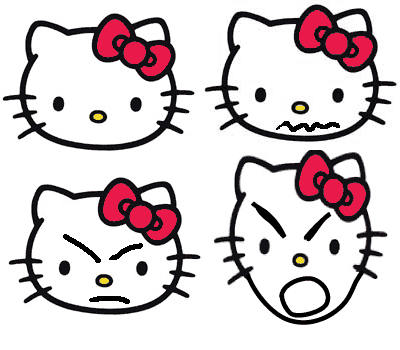 being angry with them or alternatively comforting and sympathetic, it is all up to the consumer.
As you can see in that picture, Hello Kitty looks extremely different with eyebrows or with a mouth. And with the exception of the bottom right, they all look like plausible facial expressions that Hello Kitty could have.
The soft, silent comfort that she gives not only helps her customers alleviate stress or sadness they may have, but also strengthens the bond between them. As with comfort foods, when some people feel down and horrible they comfort themselves with treats, this food gives them a positive feeling. The person consuming the food makes a direct correlation between the food and this good feeling. The same is with Hello Kitty, we see people who buy and talk with their Hello Kitty product and feel better because of it. So they end up buying more of her products, to feel the same way they did before.
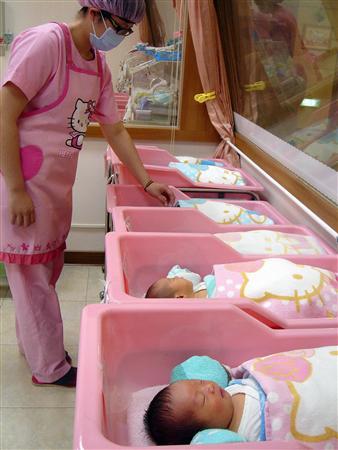 you up in her world, and if you are in her world maybe you will not feel the pain that you have in the real world.
Moreover, Hello Kitty’s face shape adds to her “cuteness”. It is a very agreeable oval with no  sharp tips anywhere. As you can see in the official “How to draw Hello Kitty in 9 easy steps” guide, you start off with a simple oval. We discussed in class how circular shapes are pleasing to the eye and comforting to the mind when we looked at the sculptures in the
Also in continuing with the simple, yet pleasing, shapes that make up Hello Kitty, let’s move onto her body. Notice again how nothing is pointy or sharp, but how everything is smooth and rounded out. This is a trait of a young animal their body parts have not had time to grow in  children or adults, this is why Hello Kitty has stuck with people from when they were children all the way to adulthood. Hello Kitty is easily remembered and drawn, and since there are very simple details it is easy to accept the image in our heads.
Now let’s go into detail about how Hello Kitty managed to become part of the visual culture of
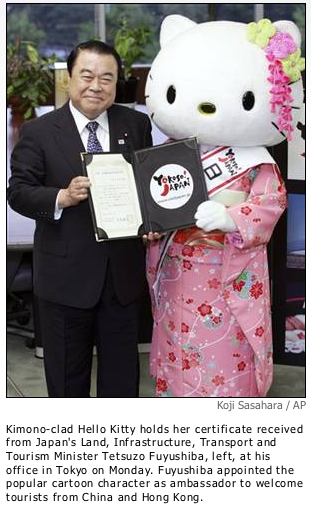 In this video, you will see an American newscaster reporting on Hello Kitty’s rise as the official Japanese travel ambassador to
For a variety of reasons, but mostly because of globalization, Hello Kitty is no longer just an icon of visual culture in
The Perversion of Hello Kitty
The perversion of Hello Kitty or changing how she normally looks to something completely different gives almost everyone who sees it a certain sense of forbidden enjoyment. There seems to be a certain guilty pleasure to be had, especially found on the internet, in taking something that is beloved and making it into something it was never supposed to be.
For instance, here is a video about the makeup line that was co-created by MAC and Hello Kitty. While the first two minutes are seemingly normal, once she enters the portal that is when the perversion of Hello Kitty takes place. We see Hello Kitty no longer as a cat, but as a woman who is definitely not a 3rd grader. She is dressed up in clothing akin to something a Dominatrix would wear and has five men dressed up in slave-like costumes with Hello Kitty heads on, these Hello Kitty masks add to the S&M theme. This video’s set up reminds many people of Alice in Wonderland, with how the female character is following a cat, who is supposed to be Hello Kitty, into a hole that will lead her to a whole new world. In this video we see Hello Kitty transformed from a cute kitten on a purse to a sex icon. Not to say that is not a bad thing, if 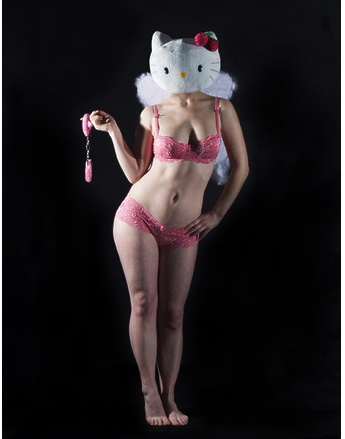 Hello Kitty, normally the pristine white cat that children love, can turn into something sexy and dominating.
On a little bit of the disturbing side we find images like this one. …Just some food for thought.
On a similar note to this, as I am sure you know there are love hotels in
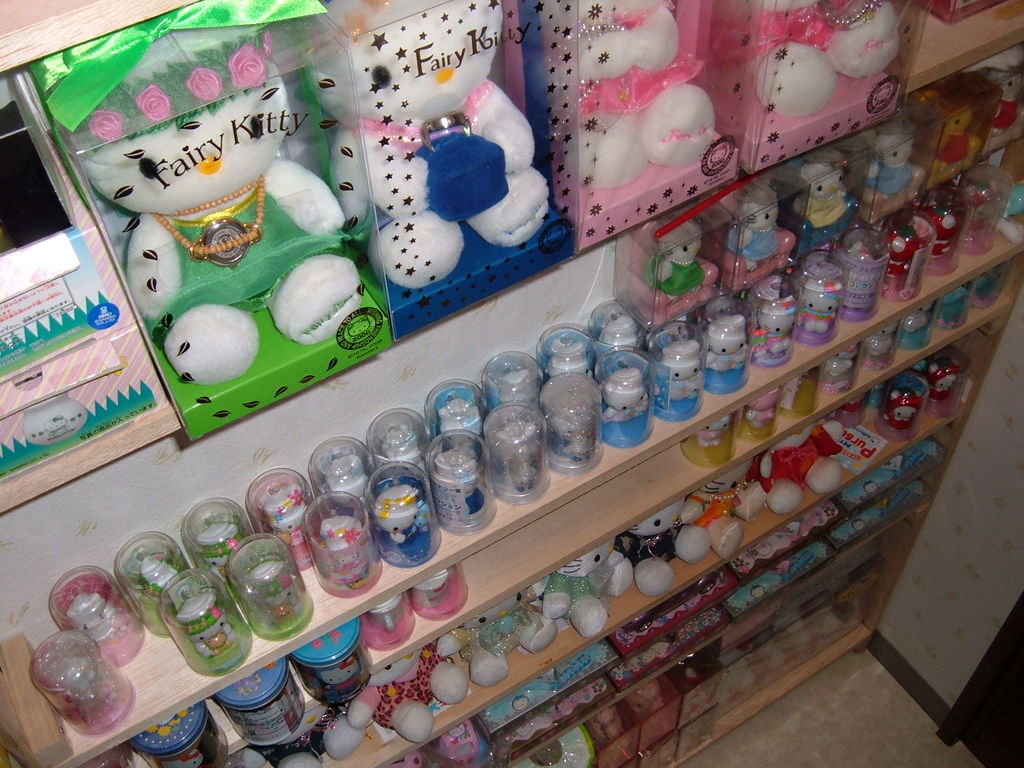 Hello Kitty Hell. It is about a man whose wife is obsessed with Hello Kitty, and he has thousands of Hello Kitty items in his house. There is a term used for people who are this obsessed about Hello Kitty and it is “Kiti-ra”, some sites have said that the Kiti stands for Kitty and the ‘ra’ is a way of saying ‘er’ so the translated word would be a ‘kittier’. The fact that the Japanese have coined a term for the people who are so obsessed with Hello Kitty proves that there is a growing population who find Hello Kitty to be the center of their lives, and to add a word into their language is akin to admitting that Hello Kitty is part of
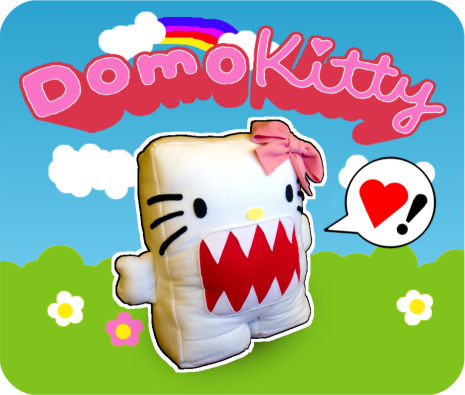
Hello Kitty not only is a key part of
As Google defines it, visual culture “acknowledges the fact that we live in a world where visual media is has a dominant influence on our lives and they way we understand the world”. Hello Kitty dominates every form of visual media, and definitely influences the lives of her consumers. Hello Kitty, although a recent item in the span of time, is part of


Whoops, forgot the sources.
ReplyDelete~*~*~Books~*~*~
Belson, Ken, and Brian Bremner. Hello Kitty The Remarkable Story of Sanrio and the Billion Dollar Feline Phenomenon. New York: Wiley, 2003.
Goldstein, Jeffery H., David Buckingham, and Gilles Brougère. Toys, Games, and Media. Mahwah: Lawrence Erlbaum, 2004.
Haig, Matt. Brand Royalty How the World's Top 100 Brands Thrive & Survive. London: Kogan Page, 2006.
Japanification of children's popular culture from godzilla to miyazaki. Lanham, Md: Scarecrow P, 2009.
Kelts, Roland. Japanamerica How Japanese Pop Culture Has Invaded the U.S. New York: Palgrave Macmillan, 2007.
Locher, Christine. The Cult of Cuteness in Japanese Youth Culture. Munich: GRIN Verlag, 2007.
~*~*~ Webpages ~*~*~
http://en.wikipedia.org/wiki/Hello_Kitty
http://web-japan.org/kidsweb/archives/cool/04-03/kitty.html
http://web-japan.org/trends/arts/art040402.html#
http://www.popcultmag.com/criticalmass/books/kitty/hellokitty1.html
http://www.hellokittyuniverse.com/page/Hello+Kitty+Fun+Facts
http://www.hellokittyuniverse.com/page/Hello+Kitty+Biography?t=anon
http://www.freewebs.com/kitty66/hellokitty.htm
I really liked reading your paper! It was super cute~
ReplyDelete