Thursday, May 14, 2009

Hello Kitty Thesis


Hello Kitty as a Cultural Icon

Hello Kitty is more than just a cartoon character; she has become world famous and beloved by millions. I will address the following questions in this paper: 1) How has Hello Kitty found her way into the hearts of so many people? 2) What makes Hello Kitty “cute” and such a successful design? 3) How has “soft power” led to Hello Kitty’s appointment as the official Japanese travel ambassador to China and Hong Kong? 4) How has she risen to become a cultural icon synonymous with Japan? 5) How has the perversion of Hello Kitty increased her popularity and fan base? In answering these questions, I will also talk about her rise from a character on a purse to an international visual icon, and one of the most prominent pieces of Japan’s visual culture.

The History of Hello Kitty

Hello Kitty was created in 1974 by the artist Ikuko Shimizu who was given the job of creating “a cartoon animal who would appeal to the preteen girl in everyone” by the company Sanrio. Hello Kitty first appeared on a vinyl coin purse in November of 1974, and has been around ever since. Sanrio was established in 1960s and produces many characters, all aimed at the female preteen audience. However Hello Kitty is by far their most well known and most popular creation. Hello Kitty is just a nick name and her “official” name is Kitty White.

In addition to creating the image, Ikuko Shimizu also designed a simplistic history to accompany Hello Kitty. She lives in the suburbs of London, with her family, the Whites. Although we are given the names of her family members (Mother is Mary; Father is George; twin sister is Mimmy), the rest of her history and relationships are left to the consumer’s imagination.

As her commercial popularity has grown, Sanrio has created additional characters for Hello Kitty’s fictitious world. The family has expanded to include Grandma (Margaret) and Grandpa (Anthony) White, and now has a pet cat of their own named Charmmy Kitty. Hello Kitty has made friends, including Bear, a living teddy bear, and Moley, who pops up in the garden. Some more of her friends include the teen bunny Kathy, brother and sister monkeys Timmy and Tammy, and boy puppy Jody. And more characters are added as the years go by, even as I write this I can find multiple websites with many different characters with lists of all her friends.

In 1993 Sanrio decided to introduce Dear Daniel, Hello Kitty’s boyfriend. However, the two of them rarely see each other, since Daniel is often with his father, a photographer who travels the world.

Hello Kitty was introduced to the public on November 1st, 1974—this date has since become her (and her twin sister Mimmy’s) birthday. She has type A blood, and an official height of five apples and a calculated weight of about three shiny apples. Even though she is well into her 30s she is still in the 3rd Grade, and has maintained her weight well. As to why place the White family to England? Well, at the time there was a large Anglophilia, or love of England, movement in Japan, so Sanrio thought it would be a good idea to usher in Hello Kitty with this fad.

Why is She Popular?

Ever since that first vinyl purse of Hello Kitty, Sanrio has been pushing her icon into every market they can. When I went to Japan I must have seen tons of Hello Kitty related advertisements, even on the train to school. Recently, while browsing the web to find some Hello Kitty related news articles, I found out that she recently joined up with a well known make up brand, MAC. Sanrio knows that, almost always, whatever Hello Kitty endorses flourishes.

But why can Hello Kitty endorse a Canadian make up brand when she is supposed to be a cat that lives in London? Well, this is all part of the charm that makes Hello Kitty, Hello Kitty. As noted previously, she lives in London with her family. This is really all that people might know about her (even Mizenko Sensei did not know about her hometown until recently). Because of this lack of a background story, Hello Kitty is versatile. She can go anywhere and do anything because there is no extensive back story that prevents her from doing it.

Hello Kitty was well made to be able to export herself to the world. She is supposed to live in London, but everyone thinks she is from Japan, and within Japan it is not hard to believe she comes from your town. When I have been in Japan, I noticed nearly every shop has a Hello Kitty item in it, but that is not the most impressive thing about Hello Kitty. It is the costumes, outfits, and props she is holding in each store that differs and is unique to the town that she is in. When I went to Kyoto, I saw (and purchased) a Hello Kitty in a Geisha costume cell phone charm, and when I was in Tokyo I saw Hello Kitty Godzilla cell phone charm.

My home stay sister Hanano brought me some presents from Japan when I hosted her; one of these was a pen with a Hello Kitty design and charm attached. She proceeded to explain to me that the castle design on the pen was specific to her town and the food that Hello Kitty was holding was what the town was well known for. Another website I found, Trends in Japan, wrote that “about 50,000 different Hello Kitty products are produced each year worldwide. There are even regional Hello Kitty products developed as local souvenirs; examples include Hello Kitty gyoza from the city of Utsunomiya and Hello Kitty natto from Mito.”

I think that one reason why Hello Kitty has become so popular is because of this versatile nature of hers. Hello Kitty is a blank canvas and you can create your own image of her based on your preferences. She can wear traditional Japanese clothes and she can wear Gothic Lolita clothing too, and nothing about her character would change, it is just like playing dress up to her. Her current designer Setsuko Yonekubo, who was appointed this position in 1976, said "Hello Kitty can wear Laura Ashley but also punk rock leather. She has a wide audience, and she's very flexible because everything goes with white." While she is wearing the costumes— you, the consumer, buy into the idea that Hello Kitty represents the image and the history of the symbol that is the costume.

What Makes Hello Kitty Cute?

First off to understand why Hello Kitty is cute, I feel that we should explain what cute is. Google dictionary defines cute as “a kind of attractiveness commonly associated with youth and appearance”, similarly Princeton defines it as “cunning: attractive especially by means of smallness or prettiness or quaintness”. So, cute is small, young, and pretty which are all found in Hello Kitty.

Hello Kitty is small, she weighs the same as three apples remember? But why did the designer decide on apples and not weigh her in pounds or in grams? Using apples as a weight measurement sounds so much cuter, and makes you smile because almost everyone loves apples. Apples make you think of fall, which is a season almost everyone likes too, so with these associations the consumer is already attracted to Hello Kitty even more.

But why is it so important for her, or anyone else, to be cute? Cute is a worldwide accepted term that everyone wants to have said about them. When a mother is walking a baby, no matter what gender it is, the nicest thing you can tell the mother is “Oh, what a cute baby!” and in Japan the same thing is said, “かわいい!” Everyone wants cute things because they are warm and friendly things in a harsh world. Cute things wrap you up in simple shapes and small features that are the polar opposite of the real world where things are large, complicated, cold and impersonal.

In this picture Hello Kitty is placed next to a real cat and a baby. As you can see, Hello Kitty has a proportionally large head associated with a baby or young animal, and is inherently cute, especially when the baby or young animal cannot even raise its own head. This is all very appealing to people because there is a sense of maternal obligation to help this vulnerable animal. Hello Kitty just asks to be comforted by you and who are you to deny her wishes?

I also polled my classmates as to what they thought was the cutest part of Hello Kitty. And many of them thought that the lack of a mouth was really what attracted them to Hello Kitty. Now this lack of a mouth has caused many feminists to paint Hello Kitty as a picture of what men might think of as “the perfect woman”. What feminists mean by this is that Hello Kitty, cannot talk and can only listen to you, she is small and cute, which are also things that the stereotypical male likes. So by their reasoning Hello Kitty is the ultimate subservient woman, I however disagree. Hello Kitty is a so called ‘soft power’, she is not making a bold statement, and I doubt that the designer thought “I am making a cat without a mouth to say that women should be subservient to men” when she was creating Hello Kitty. Hello Kitty would look strange with this feature, because there is no room on her head to accommodate a mouth. But also because she has no mouth she is able to listen to the problems that her consumers tell her, and she has not expression except for the one that you see on her face.

In addition to not having a mouth, Hello Kitty has no eyebrows, which also helps with her expressionless face. Eyebrows are essential to showing emotion, without them it is hard to tell if someone is angry or exuberant. On a website I found, it said that the eyebrows can completely change the expression of a person. In conjunction with a mouth you get a set of emotions that are limitless. However, take out these two things there is only one look- a blank stare. A person could see whatever emotion they wish on Hello Kitty’s face, because it is easy to project their mood onto her face. For instance, if the consumer was angry they could either see Hello Kitty as being angry with them or alternatively comforting and sympathetic, it is all up to the consumer.
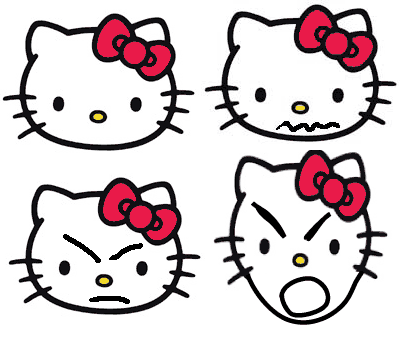
As you can see in that picture, Hello Kitty looks extremely different with eyebrows or with a mouth. And with the exception of the bottom right, they all look like plausible facial expressions that Hello Kitty could have.

The soft, silent comfort that she gives not only helps her customers alleviate stress or sadness they may have, but also strengthens the bond between them. As with comfort foods, when some people feel down and horrible they comfort themselves with treats, this food gives them a positive feeling. The person consuming the food makes a direct correlation between the food and this good feeling. The same is with Hello Kitty, we see people who buy and talk with their Hello Kitty product and feel better because of it. So they end up buying more of her products, to feel the same way they did before.
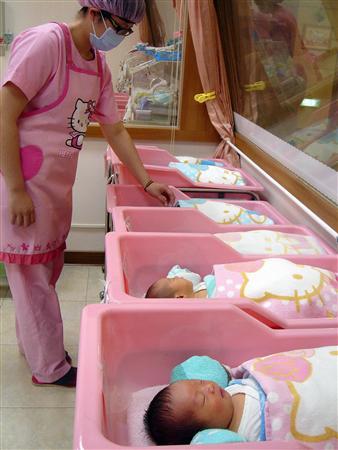
This is why I believe such places as the Hello Kitty Hospital, in Taiwan, were created. The hospital is not only filled to the brim with Hello Kitty paraphernalia, but the beds, nurses and everything in between has Hello Kitty on it. Hello Kitty is a charming little character that will wrap you up in her world, and if you are in her world maybe you will not feel the pain that you have in the real world.

I think that this hospital is using a similar tactic as pediatricians use when checking up on a young child. The doctors have cartoon characters attached to their stethoscope to make it seem less scary, or they have pictures of well known and beloved characters in the room to distract the child from whatever they are doing. This is exactly what this hospital is doing, just on a larger scale. The patients are distracted by the pink or light blue, which are comforting colors, and do not notice the usual discomforts of a hospital visit. Also, with no expression to mock you, you can think that Hello Kitty is there to comfort you as a real cat would. The Director of the hospital, Tsai Tsung-chi, said to the press that“[he hopes] the cuddly feline will help assuage the fears and difficulty of childbirth among its patients. Tsai expresses his hope that young mothers suffering from illness and birthing will smile and relax when they see the images of the adorable cat.” Although I think that most mothers will still feel the pains of child birth, I think that having a calm and comforting environment can help minimize their unease.

Moreover, Hello Kitty’s face shape adds to her “cuteness”. It is a very agreeable oval with no sharp tips anywhere. As you can see in the official “How to draw Hello Kitty in 9 easy steps” guide, you start off with a simple oval. We discussed in class how circular shapes are pleasing to the eye and comforting to the mind when we looked at the sculptures in the Hiroshima Peace Gardens. I think that this is because there are no loose ends in a circle so you feel that there is nothing to break it apart. In nature there are so many things that have a circular shape, because circles and spheres are the most compact and simple way to hold things. So seeing a circle is one of the most common and pleasing shapes around, and that is the basis for Hello Kitty’s face.

Also in continuing with the simple, yet pleasing, shapes that make up Hello Kitty, let’s move onto her body. Notice again how nothing is pointy or sharp, but how everything is smooth and rounded out. This is a trait of a young animal their body parts have not had time to grow in yet but this is also the charm of Hello Kitty. This is why she has become so popular. I think that because of this simple drawing, so easy a child could draw it well enough that you would be able to understand what it was trying to be, that it stuck in the hearts of consumers. Complicated images do not stick well in the minds of children or adults, this is why Hello Kitty has stuck with people from when they were children all the way to adulthood. Hello Kitty is easily remembered and drawn, and since there are very simple details it is easy to accept the image in our heads.

Now let’s go into detail about how Hello Kitty managed to become part of the visual culture of Japan. Well, if you grow up seeing something you associate that something with you and your life, which is true to thousands of people in Japan. Japanese adults saw Hello Kitty when they were children, and saw her often because of her blossoming popularity. Sanrio started having more and more advertisements that featured Hello Kitty, so people would have to see her on a daily basis. Due to Hello Kitty’s pervasive presence, she became a symbol of Japan. It was not a sudden coup d’etat, but the slow rise of “soft power”. She became a national icon gradually, slowly beating one Japanese heart at a time into submission- killing with cuteness. As you can see the Japanese have not only accepted the idea that “Hello Kitty = Japan” but also that “Japan= Hello Kitty”.
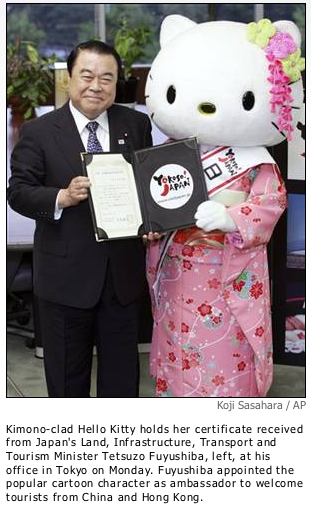
In this video, you will see an American newscaster reporting on Hello Kitty’s rise as the official Japanese travel ambassador to China. However, the reporter’s tone is disrespectful of the government’s decision to use this icon for diplomatic means. Historically, the Japanese and Chinese have had a tumultuous relationship, especially due to the Rape of Nanking, during World War II. I think that this was very smart idea. So to use a character that is very widely know and well liked as a bridge between the two countries was a very smart move on behalf of Japan. And as mentioned before Hello Kitty, although she is associated with Japan, is still free to wear whatever and be whatever she wants, so she can wear both Chinese and Japanese traditional clothing and it is not a problem.

For a variety of reasons, but mostly because of globalization, Hello Kitty is no longer just an icon of visual culture in Japan, but also in America and all over the world. This is an example of the “Soft Power” that we discussed in class. Rather than Japan having power in military or diplomatic areas, Japan has power over culture changes. Thousands of children have grown up with Hello Kitty before they can locate Japan on a map. This is significant because instead of just being part of the visual culture of Japan, Hello Kitty has risen to the stage of the world’s visual culture. Like Mickey Mouse, Harry Potter, American Cowboys, and the British Bobby, Hello Kitty has assimilated herself into this elite cultural grouping.

The Perversion of Hello Kitty

The perversion of Hello Kitty or changing how she normally looks to something completely different gives almost everyone who sees it a certain sense of forbidden enjoyment. There seems to be a certain guilty pleasure to be had, especially found on the internet, in taking something that is beloved and making it into something it was never supposed to be.

For instance, here is a video about the makeup line that was co-created by MAC and Hello Kitty. While the first two minutes are seemingly normal, once she enters the portal that is when the perversion of Hello Kitty takes place. We see Hello Kitty no longer as a cat, but as a woman who is definitely not a 3rd grader. She is dressed up in clothing akin to something a Dominatrix would wear and has five men dressed up in slave-like costumes with Hello Kitty heads on, these Hello Kitty masks add to the S&M theme. This video’s set up reminds many people of Alice in Wonderland, with how the female character is following a cat, who is supposed to be Hello Kitty, into a hole that will lead her to a whole new world. In this video we see Hello Kitty transformed from a cute kitten on a purse to a sex icon. Not to say that is not a bad thing, if anything this widens Hello Kitty’s fan base to include more people. This sort of thing attracts people because Hello Kitty, normally the pristine white cat that children love, can turn into something sexy and dominating.
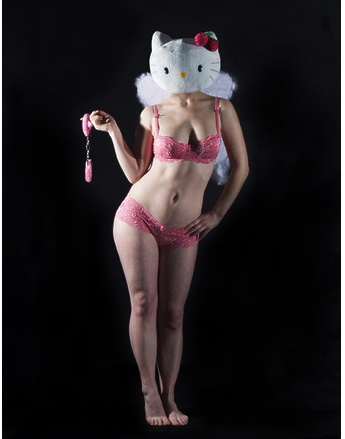
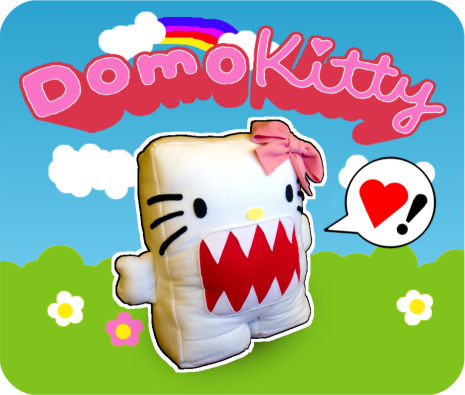
On a little bit of the disturbing side we find images like this one. …Just some food for thought.

On a similar note to this, as I am sure you know there are love hotels in Japan. Many have themes, and Sadism & Masochism is a popular one. One of the more famous rooms with the bondage them is the Hello Kitty Bondage Room, in Hotel Adonis in Osaka. Although the room is no longer there (the hotel itself was shut down) millions of online fans wanted to go. Why would fans want to get chained up with their favorite 3rd grade cat looking at them? As Misty Keasler, the photographer who first published the pictures, said in an interview “I think the room would probably appeal to a girl’s [interest in] cuteness, and the S&M part of the room [appeals] to a man’s more sexual interests. Though, I think most Japanese girls probably giggle when they see the cuffs-and-bondage Kitty.”
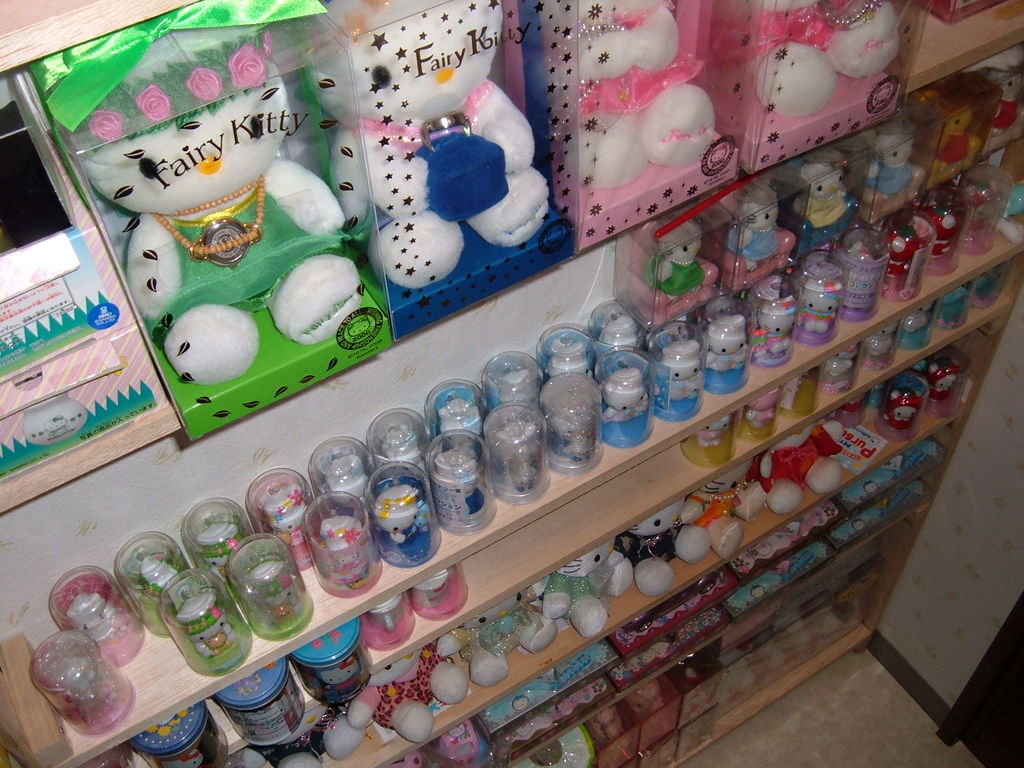
If you are interested in seeing a whole list of Hello Kitty items then I recommend the website Hello Kitty Hell. It is about a man whose wife is obsessed with Hello Kitty, and he has thousands of Hello Kitty items in his house. There is a term used for people who are this obsessed about Hello Kitty and it is “Kiti-ra”, some sites have said that the Kiti stands for Kitty and the ‘ra’ is a way of saying ‘er’ so the translated word would be a ‘kittier’. The fact that the Japanese have coined a term for the people who are so obsessed with Hello Kitty proves that there is a growing population who find Hello Kitty to be the center of their lives, and to add a word into their language is akin to admitting that Hello Kitty is part of Japan’s culture.
Conclusion

Hello Kitty not only is a key part of Japan’s visual culture, but she has also become part of the global visual culture. There is no way to deny that she is not an important part of Japan’s economy, not only because she is the tourism ambassador, but also because she has her own theme park. Sanrio Puroland in Tokyo that attracts over 1.5 million visitors a year, with a maximum of five couples allowed to get married there annually. Being a integral part of the economy means that Hello Kitty, like other celebrities, endorses many products, and thus increases the number of people that see her per day. The more people see her, the more people will associate her with their life and culture.

As Google defines it, visual culture “acknowledges the fact that we live in a world where visual media is has a dominant influence on our lives and they way we understand the world”. Hello Kitty dominates every form of visual media, and definitely influences the lives of her consumers. Hello Kitty, although a recent item in the span of time, is part of Japan’s visual and economic culture and is here to stay.


Thursday, April 16, 2009

I don't know why I love hello kitty.


In my paper I am exploring Hello Kitty. I am looking into why she is as cute as she is. I also want to figure out why she has gotten so popular in the world (although this might be impossible I will try my best).


This is a older picture of Hello Kitty.

Compared to this new version of Kitty.

Currently I have a very rough outline of what I want to discuss in my paper. It is as follows.

  1. The History of Hello Kitty
  2. Why is she so popular?
  3. What makes her so cute?
  4. The success of making her be able to go anywhere

Also, remember that discussion board we all made (or were supposed to make) accounts for? Well I made a thread asking for your opinions on what part of Hello Kitty was the cutest. It is here. I would greatly appreciate your help on this.
More Images


Saturday, April 4, 2009

Nagasaki

My high school allowed us to go to Japan for two weeks every year, this past year I went with around 25 students to Nagasaki for our one week of touring. Here are some pictures I took.


Here are pictures of Nagasaki I took in 2008

Friday, March 27, 2009

★☆ 私 の 好きな かわいい 物 ★☆ (The cute things I like, with stars surrounding it :D )


V W X Yellow Elephant Underwear, H I J Kiddy Elephant Underwear
Chinatsu Ban
2005

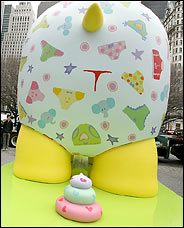
I actually saw this sculpture in real life, and somewhere I have a picture of me standing next to the bigger Elephant with children swarming all over them. (You can't quite see it from this picture- but there is a little dung heap in the back too, which incedentily is my favourite thing in this peice.) When I first saw these two statues I thought, okay they are cute... but not "squee! I want one for myself!!" cute. I was confused by all the eyes, and I still am to an extent. But this sculpture is a very quintessential example of what cute has become.
First, allow me to define cute: As google puts it, cute means "attractive especially by means of smallness or prettiness or quaintness" which is something we all agree on. Something small is usually cute, so that explains the little elephant to the right. But many people also would find this statue attractive because of it's simplicity. You see no wrinkles in the skin like real elephants, instead you get a elephant that has been simplified to it's most famous charcteristics- it's long trunk and big ears. But all of it's other features have been deformed. (Like it's tail, this is what a real elephant looks like) As you look at the real elphant scroll up to see the statue again, you can see how there are no tusks- that is because the sculpture is to remind you of childhood, or innocence because baby elephants have no tusks. (Remember Goolge also defined cute as "Possessing physical features, behaviors, personality traits or other properties that are mainly attributed to infants and small or cuddly animals".)

One thing that I think is cute, but Google does not nessicarily agree with me, is that silly things can be cute too. I believe this because people do silly things by accident or on purpose because they want to portray innocence. That is why I think this dung in the back is cute, it is silly and makes the piece a bit morelikeable. (Also the hearts on it make it pretty cute as well... Hearts are just cute, because of what they stand for and what they look like) And I have to say I am digging the underwear with the pictures of underwear (my mom's favorite thing about this sculpture), again is it silly but you can't help but want to see what other types of undies were painted on...

The second "cute" thing I found is a video that I am sure many of us have seen already. It goes along with the "Possessing physical features, behaviors, personality traits or other properties that are mainly attributed to infants" definition of cute that our lord Google has granted us (a joke please don't hurt me).


(Real video can be found here)

So, as you can see this video is a small clip in time focusing on two brothers who are (probably a little) bored. Their innocence and behavior calls out to us and makes the viewer smile at their antics. And that the video is humourous also makes us feel a little more attached to it. I have found that cute things usually give you a good feeling, thus so why you become attached to it. If not for attachment then why else would we get things like this, this, this, and this? (yeah... the last two kinda freaked me out too)


--- Since Sensei wants us to do something Japan related for our second image- I am changing the Charlie Bit Me video to this one.
(Again, the original video can be found here)

In this video, we see inanimate objects become subject to something that almost always is cute. Anthropomorphism. For some reason, seeing objects come alive and act out things is just so unbearably cute! For example here, here, here, and here.

There is something also that is very cute about having very simple shapes for an object. As mentioned with the elephant statues, simplifying a object down to the very basics makes it easier on the eyes, and so more cuddly. For example- the cute, and kawaisou, Tare Panda looks nothing like the real thing- only the colors and basic body shape tell you that it is a panda (the name also helps).

This also relates back to children- babies look like their adult counterparts- only with smooth skin and with disproportionate body shapes. In this video, the pizza and the toppings have come to life and are all happy- they are dancing and singing. The pizza slice is so energetic and filled with passion- which is a cute characteristic that is displayed much more in children than adults. And then the toppings do something funny- and we see a kawaisou moment which cements our attachment to pizza. How much cuter can you get?

But really I just like the song. :)

Friday, March 20, 2009

Thursday, February 26, 2009


This is an photograph I took at a local park.
I was making prints of this picture, and I under exposed it, so I decided to colour it.

I felt like this related with our current topic in class, because the photographers also coloured in their pictures. (I used markers, while I am sure their coluring utensils were a little more complicated.)

[I thought I had another version of it up here, but I guess I don't. However you are welcome to look at the pictures or you are bored. There happen to be a couple of other pictures of the same park in this album.]

My Album

Pictures taken from Triptych

I wanted to start off this album with a picture of a 'modern' Japan. We see a person diving into the pool backwards, I feel that this is also how we view a forgein culture. We don't look at it head on, but we just jump in hoping things will work out.

I think this is pretty. I wanted a transitional piece, colour and subject wise. Here we see the water and the buildings in the background, which relate to the picture before it, but the focus of nature is more prevalent.

The color of red just jumps out at me, and made me want to do a album with the continuous theme of red and nature.

The focus of red is not as prevalent here, but still powerful.

And we end with another hint of red being the main focus.

Blue and Red are two of my most favourite colors, so I thought putting them together in an album would be fun. I also think that these pictures give a verity of scenes that would be of interest to Globe Trotters.

Thursday, February 19, 2009

Two Characters from the Popularized "Romance of the Three Kingdoms" (V2 Level up!)


<- Copyright 2008, Phillip and Muriel Berman Museum of Art, All Rights Reserved. The image on the left is the image you can find hanging in the Berman Art Gallery. The image below is one that I have edited to bring out the colors and to restore it to what I think the print looked like right off the final wood block.


This picture depicts two characters from the epic The Romance of Three Kingdoms, which is one of the most famous epics ever told in China and was created by Utagawa Kuniyoshi. The story opens with a weak government where the emperor was controlled by corrupted eunuchs. The leaders and generals from all the provinces started to fight against these eunuchs, who have split the country into three kingdoms, in order to unite the land of China and restore peace to the country. The story ends, after a little less than a century of war, with China once again united.

This print is called Musha-e, or warrior print. Musha-e became popular after the 1842 banning of Ukiyo-e prints that had to do with Kabuki actors and beautiful women. Because of this ban, Utagawa was able to flourish and become famous for his depictions of famous warriors. Utagawa Kuniyoshi was born in 1797 under the different name of Yanagiya Kichiemon. His father worked in textiles; he dyed silk and designed patterns. Yanagiya’s father asked Yanagiya for help in his work, because Kuniyoshi’s prints often show rich color and detail in the clothing that is said to have been influenced through helping his father. When Yanagiya turned 12 he was already noted for his drawings, but he was not formally accepted into a school until he turned 14 and was admitted into Toyokuni Utagawa’s school of art. Yanagiya was there for three years until he received the name Kuniyoshi at which time he set out to start his own work.

Although Kuniyoshi started off well, his career did not progress for many years until he received the job to create the Tūszoku Suikoden gōketsu hyakuhachinin no hitori, or one hundred and eight heroes of the popular Suikoden. Kuniyoshi became famous for this series and received many other commissions. Kuniyoshi is still most famous for his warrior prints, although he did branch out to many other sections of Ukiyo-e such as Kabuki prints, women and animals, most often depicting felines. Towards the end of his life, Kuniyoshi contracted a crippling disease that left him unable to draw his pictures in the same degree of detail. Kuniyoshi died at the age of 65 in 1862, after having a successful career and being a well admired man and teacher.

I think that these two characters are Liu Bei, the one on the right, and Cao Cao behind him. Liu Bei was one of the heroes in the epic; he started out as a good general and died as the founder of the Kingdom of Shu-Han. I feel that the man on the right is Liu Bei because he looks more like the man you would expect to be a hero, a man that is strong and capable. If we take the man on the right to be Liu Bei, then you can also see how he is played off of the foe behind him. Bei is looking over his shoulder at Cao warily, with a frown that is full of anger- a way that one looks at an enemy. Bei also looks to be steadying himself after having been attacked, he is leaning to the right with his foot and hand ready to catch him and steady him against the incline. Bei, in the epic, seems to be a very grounded man- and his armor reflects that in this image. His clothing stays close to his body, and although it is extravagant, it is fairly form fitting. His clothing is also lighter colored, so it again reinforces the idea that he is a good guy.

As to why I think the person behind Liu Bei is Cao Cao, it is because this man is very insane looking. Cao Cao led the Kingdom of Wei, but in the story he is not described in a flattering manner. He was said to be power hungry and would stop at nothing to get it. He looks animalistic in this picture and does not seem to be able to control himself. He is darker than Bei, and has clothes that seem to be whirling around him. This gives the viewer the impression that he is unstoppable, as well as uncontrollable. He looks to be laughing, which strengthens the impression of insanity or of an animalistic nature. Since his clothing is darker, there also is the idea that he is the bad guy.

As for my first impressions of this piece, they were focused on the characters looking almost like a two headed monster. This ‘monster’ looks scary, big, and hairy, which reflects on how the Japanese viewed foreigners at the time. Also the way that their weapons (which look to be pudaos) cross, draws your eyes up and down the piece. When you first look at the print you see Bei’s staff handle, because it is a light color that draws you in. Next you look at the staff itself; this lets your eye to explore the piece with it as a guide. Then you notice the clothing, faces and finally the background. It appears to be a hill on which grass does not fully cover, so it also gives a feeling of war and unrest. There are also leaves falling from the top of the print, I took this to symbolize the end of the war. Like in fall when the season, or a period of time, ends; the old is disposed of, to be replaced in time by the new.

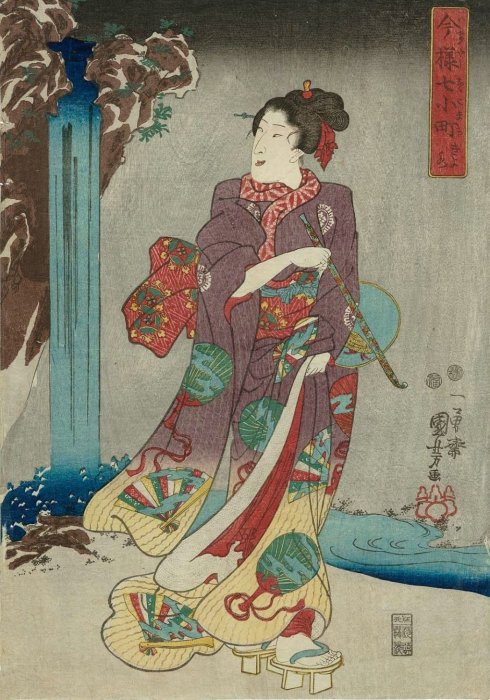
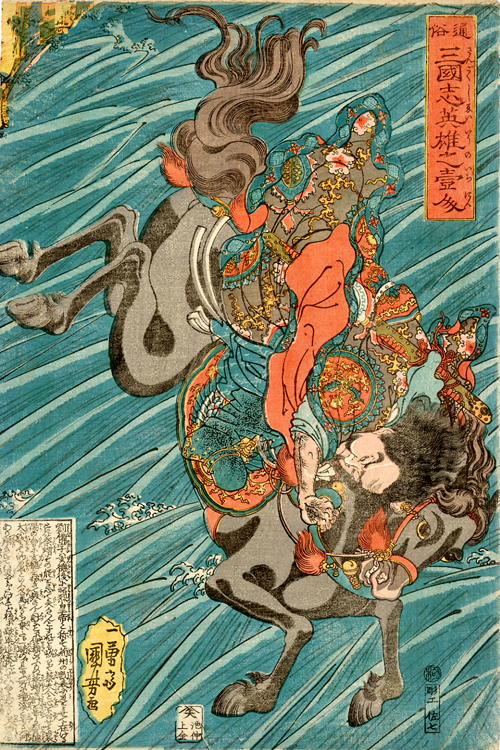
I also noticed immediately, it was the third note I wrote when I started studying the picture, that there was a major discrepancy in the print. There is a long black line running from the lower left side of the print up until past Cao Cao’s face. It is most noticeable on his face because the line causes some major discoloration. Also because of this defect, there is a rather large white spot on Cao Cao’s pant leg. This is rather distressing because this looks to be a new print because all the lines look to be crisp and bold. I think because of the ‘crack’, or defect, the colors in other parts of the print are also shifted as you can see most clearly in Bei’s left pant leg. However, this seems to not be a unique factor to this print, as you can see in this picture. This Ukiyo-e is also a later print, published in 1836, you can tell because of all the colors and detail put into it.

In conclusion you can see that Kuniyoshi employed a variety of skills in his prints. He added color and patterns into his work that made his prints even more eye catching than other prints at the time. He used perspective to give the print a feeling of hostility and action, while also displaying the character’s personalities. I really like this print, because I think it never gets old to the viewer, because there is always some detail in the clothing or in the landscape that you did not notice before.


(Bibliography)

Kuniyoshi Utagawa

http://en.wikipedia.org/wiki/Utagawa_Kuniyoshi

http://www.viewingjapaneseprints.net/texts/ukiyoetexts/ukiyoe_pages/kuniyoshi3.html

http://www.metmuseum.org/toah/hd/ukiy/hd_ukiy.htm

http://www.kuniyoshiproject.com/ + http://www.kuniyoshiproject.com/Main%20-%20Characters.htm

http://www.vam.ac.uk/images/image/40579-popup.html

Romance of the Three Kingdoms

http://en.wikipedia.org/wiki/Romance_of_the_Three_Kingdoms

http://threekingdoms.com/

http://www.shvoong.com/books/historical-novel/1643026-romance-kingdoms/

http://www.a3guo.com/renwu/shu/Guan%20Yu.htm

http://www.nationmaster.com/encyclopedia/Romance-of-the-Three-Kingdoms

http://www.mfa.org/collections/search_art.asp?recview=true&id=488535&coll_keywords=&coll_accession=&coll_name=&coll_artist=&coll_place=&coll_medium=&coll_culture=&coll_classification=&coll_credit=&coll_provenance=&coll_location=&coll_has_images=&coll_on_view=&coll_sort=0&coll_sort_order=0&coll_view=0&coll_package=36380&coll_start=1

http://www.mfa.org/collections/search_art.asp?recview=true&id=463491&coll_keywords=&coll_accession=&coll_name=&coll_artist=&coll_place=&coll_medium=&coll_culture=&coll_classification=&coll_credit=&coll_provenance=&coll_location=&coll_has_images=&coll_on_view=&coll_sort=0&coll_sort_order=0&coll_view=0&coll_package=36380&coll_start=1

http://www.mfa.org/collections/search_art.asp?recview=true&id=463511&coll_keywords=&coll_accession=&coll_name=&coll_artist=&coll_place=&coll_medium=&coll_culture=&coll_classification=&coll_credit=&coll_provenance=&coll_location=&coll_has_images=&coll_on_view=&coll_sort=0&coll_sort_order=0&coll_view=0&coll_package=36380&coll_start=1